CallCleaner

Lightweight Bioacoustic Denoising from an Audio Foundation Model

Michael Xie1 Gašper Beguš1,2 Morris Alper3

1University of California, Berkeley, USA  ·  2Project CETI, USA and Dominica  ·  3University of Miami, USA

Paper (soon) Code 🤗 Model Listen

TL;DR: Prompted with call time spans from a simple animal detector, the audio foundation model SAM-Audio removes more background noise from animal vocalizations than dedicated denoisers. We distill it into CallCleaner, a 19M-parameter denoiser that needs no detector and runs ~90× faster than real time on a laptop CPU.
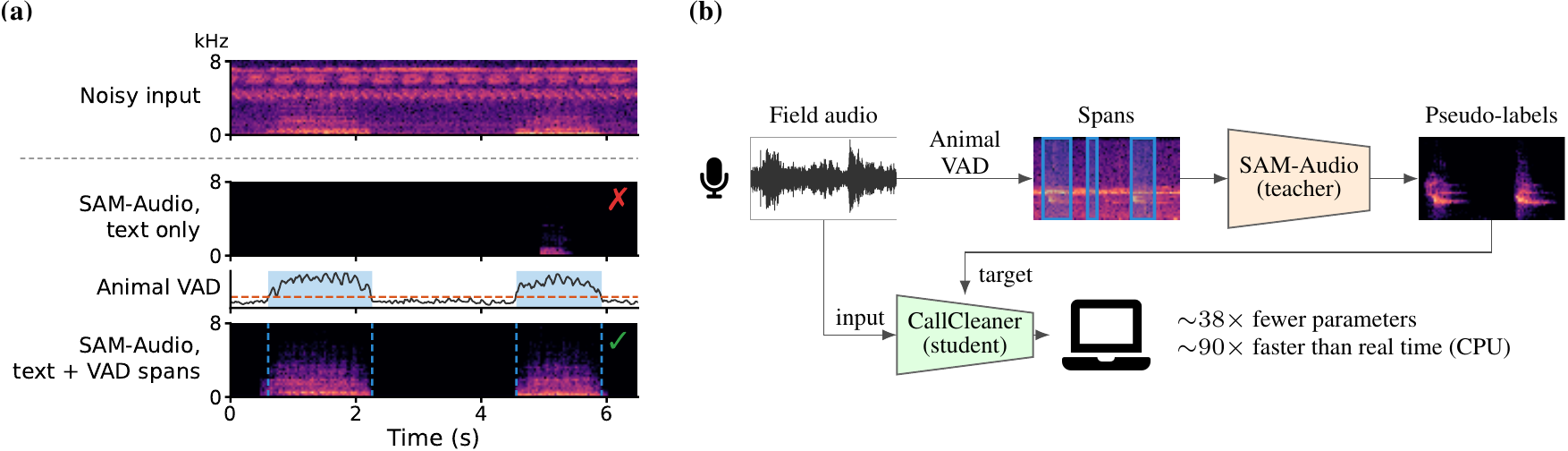
Method overview: (a) SAM-Audio with and without VAD spans; (b) distillation into CallCleaner
(a) Prompted with “animal sound” alone, SAM-Audio misses most of this horse call; prompted with time spans from a simple animal VAD, it recovers the call. (b) Its outputs on unlabeled field audio become training targets for a small, fast, detector-free student, CallCleaner.

Abstract

Many studies of animal vocalizations require clean recordings, but animals are usually recorded in the field, with background noise from weather, vehicles, and other animals. Animal vocalization denoising is challenged by the scarcity of clean training data and the extreme diversity of animal vocalizations.


Audio Examples

Clean animal calls mixed with real field noise at 0 dB SNR, from the Biodenoising benchmark. Click a spectrogram to play it (click again to pause; click elsewhere on it to jump). Each version is peak-normalized; spectrograms span 0–8 kHz, with colors relative to each clip’s loudest point. Examples were chosen for variety of animals and noise, and for open licenses.

Loading examples…

Results

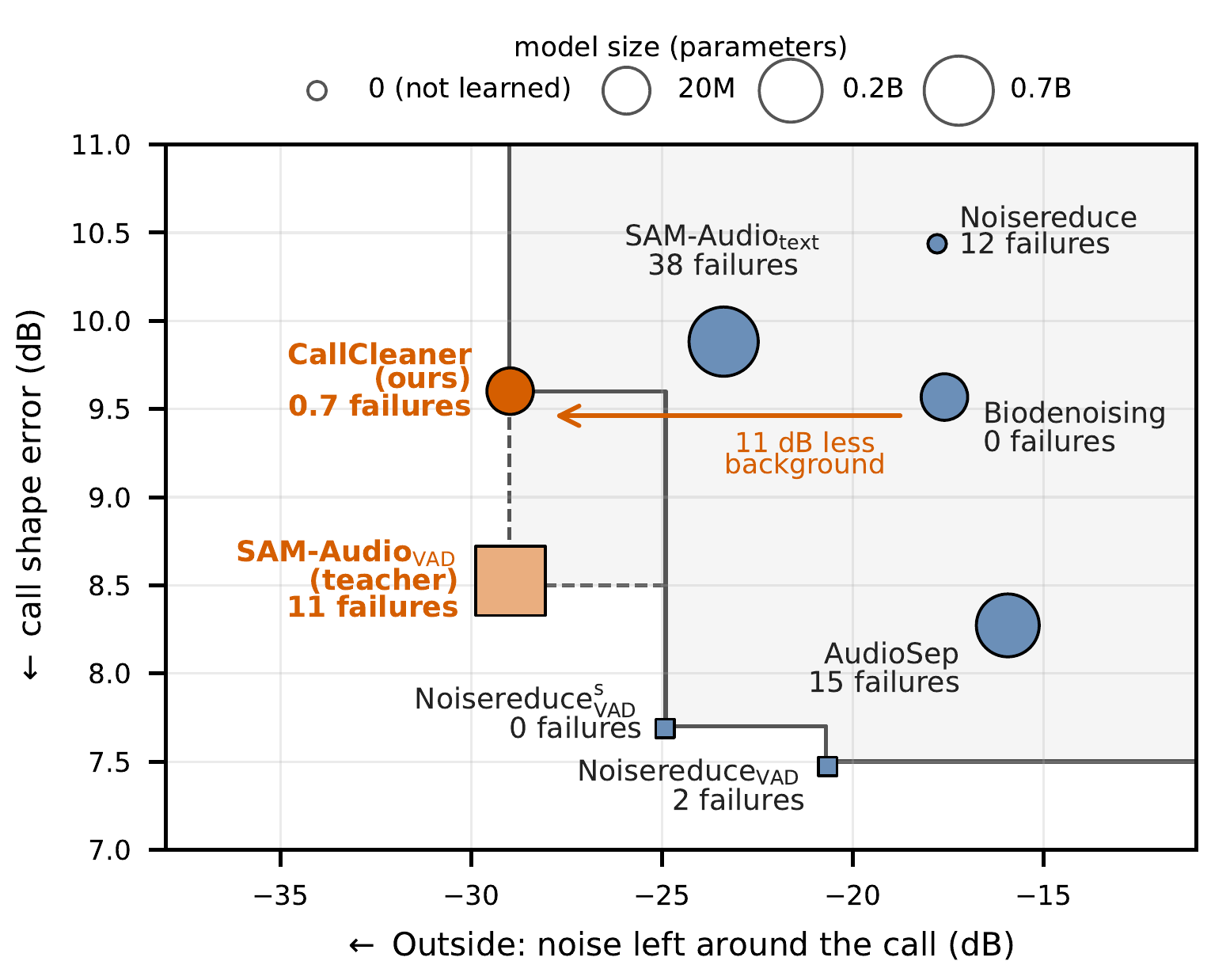
Noise left around the call vs. call shape error for all systems
  • 11 dB less noise left around the call than Biodenoising (better on 44 of 47 clips), matching its teacher.
  • Rarely fails: 0.7 catastrophic failures per 188 mixtures vs. 11 for its teacher, and no detector needed.
  • ~90× faster than real time on a laptop CPU, at Biodenoising’s size (19M parameters).
  • Trade-off: given a detector, a smoothed spectral gate keeps the call’s shape better; CallCleaner removes more noise without one.

Benchmark medians over 47 clips × 4 SNRs. Lower is better on both axes; marker size grows with model size. Dashed: Pareto frontier over all systems; solid: over systems that run faster than real time on a laptop CPU.


Citation

@article{xie2026callcleaner,
  title   = {CallCleaner: Lightweight Bioacoustic Denoising from an Audio Foundation Model},
  author  = {Michael Xie and Ga{\v{s}}per Begu{\v{s}} and Morris Alper},
  journal = {arXiv preprint},
  year    = {2026}
}

Audio credits

Mixtures from the Biodenoising benchmark (Miron et al., ICASSP 2025; for educational, non-commercial use). Original recordings from freesound.org; outputs are derivatives of these mixtures.